
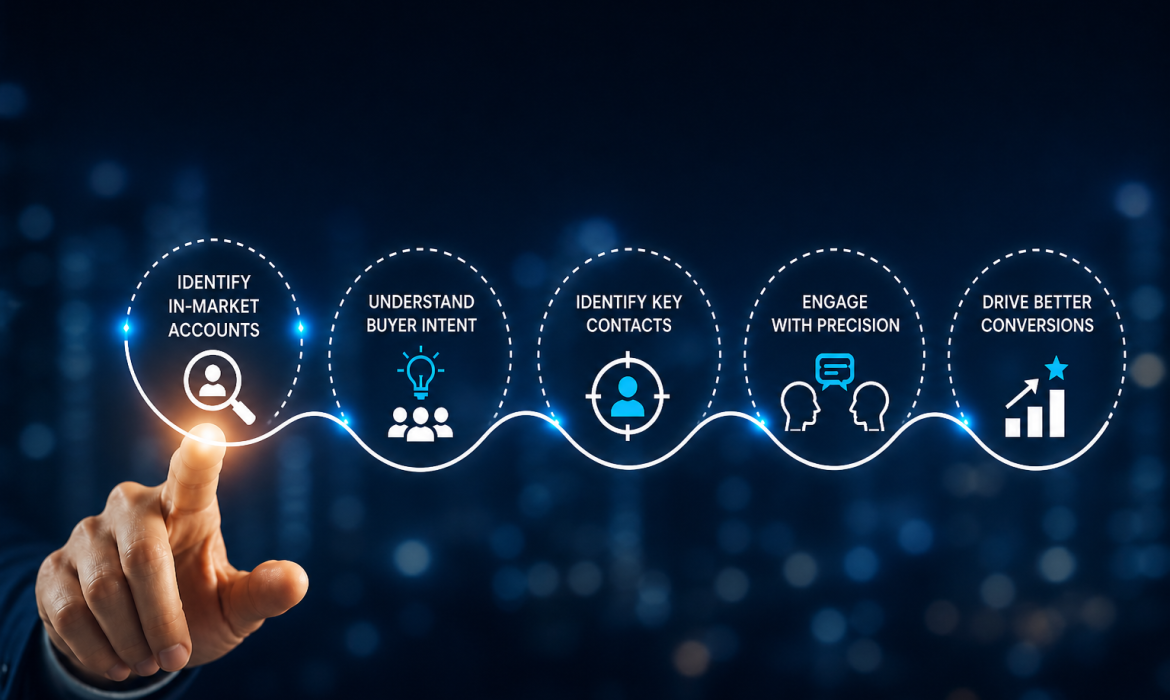
However, as intent data continues to evolve, a critical question emerges: Is account-level intent data enough to drive meaningful engagement and conversions? While it offers valuable insights into which companies are showing interest, it often lacks the depth required to take precise action.
Therefore, many marketers are now shifting their focus toward contact-level intent data, which provides a more granular understanding of buyer behavior. By combining both approaches, organizations can significantly improve targeting, personalization, and overall campaign performance.
What is Account-Level Intent Data?
Account-level intent data refers to behavioral signals that indicate a company’s interest in a particular product, service, or topic. These signals are typically aggregated from multiple individuals within an organization and analyzed to identify trends.
For instance, if several employees from the same company are reading articles about “cloud security” or “HR automation tools,” it suggests that the organization may be exploring solutions in that space. As a result, marketing and sales teams can prioritize that account for outreach.
Key benefits of account-level intent data include:
- Identifying companies that are actively in-market
- Prioritizing high-potential accounts
- Enhancing account-based marketing (ABM) strategies
- Aligning marketing and sales efforts around shared targets
Moreover, account-level data helps businesses allocate resources more efficiently by focusing on accounts that are more likely to convert.
However, there is a limitation. While it tells you which company is interested, it does not reveal who within the company is driving that interest. This lack of visibility can reduce the effectiveness of outreach efforts.
Where Account-Level Intent Falls Short
Although account-level intent data provides a strong starting point, it often falls short when it comes to execution. In B2B environments, purchasing decisions are rarely made by a single individual. Instead, they involve multiple stakeholders across different roles and departments.
Consequently, relying solely on account-level data creates several challenges:
- Unclear buyer roles – You cannot distinguish between a decision-maker and a casual researcher
- Inefficient outreach – Sales teams may contact the wrong individuals
- Limited personalization – Messaging remains broad and less relevant
- Longer sales cycles – Lack of precision delays meaningful conversations
For example, an organization may show high intent for marketing automation tools. However, if the engagement is coming from junior executives rather than decision-makers, the likelihood of conversion may still be low.
In addition, generic outreach based on account-level insights often leads to lower response rates. Without understanding the specific needs and responsibilities of individual contacts, it becomes difficult to craft compelling messages.
What is Contact-Level Intent Data?
Contact-level intent data takes intent analysis a step further by focusing on individual buyers within an organization. Instead of aggregating signals at the company level, it identifies specific contacts who are actively engaging with relevant content.
These signals may include:
- Visiting product pages or pricing pages
- Downloading whitepapers or case studies
- Attending webinars or virtual events
- Engaging with emails or targeted ads
For instance, rather than simply knowing that a company is researching CRM software, contact-level intent data reveals that the Head of Sales or Marketing Director is actively exploring solutions.
As a result, this level of insight enables businesses to take more precise and informed actions.
Why Contact-Level Intent is a Game Changer
Contact-level intent data significantly enhances the effectiveness of B2B marketing and sales strategies. By focusing on individuals rather than just accounts, organizations can unlock several advantages.
- Precision Targeting
Instead of casting a wide net, businesses can focus on high-value contacts who are more likely to influence purchasing decisions. - Personalized Messaging
With deeper insights into individual behavior, marketers can tailor messages based on specific interests, roles, and pain points. Consequently, communication becomes more relevant and engaging. - Faster Sales Cycles
Reaching the right person at the right time accelerates the decision-making process. Sales teams can initiate meaningful conversations earlier in the buyer journey. - Improved Conversion Rates
When outreach is both timely and relevant, the likelihood of conversion increases significantly. - Better Sales and Marketing Alignment
Both teams can work with a shared understanding of who to target, leading to more coordinated and effective campaigns.
In essence, contact-level intent transforms intent data from a broad signal into a highly actionable insight.
Account vs Contact Intent: Why You Need Both
Despite the advantages of contact-level intent data, it is important to recognize that account-level insights still play a crucial role. Rather than viewing them as competing approaches, businesses should see them as complementary.
- Account-level intent identifies where to focus
- Contact-level intent determines who to engage
By combining both, organizations can develop a more comprehensive targeting strategy. For example, account-level data can highlight a shortlist of high-intent companies, while contact-level data pinpoints the key decision-makers within those organizations.
This integrated approach ensures that outreach efforts are both strategic and efficient.
Real-World Example
Consider a company offering HR technology solutions. Using account-level intent data, the marketing team identifies ten companies that are actively researching HR software.
However, without contact-level insights, the sales team may struggle to identify the right individuals to approach.
Now, by incorporating contact-level intent data, the team discovers:
- At Company A, the HR Manager is browsing content casually
- At Company B, the CHRO has downloaded multiple resources and attended a webinar
Clearly, Company B represents a stronger opportunity. As a result, the sales team can prioritize outreach to the CHRO with personalized messaging, increasing the chances of conversion.
How to Use Both Together
To maximize the value of intent data, organizations should adopt a layered and strategic approach:
- Identify High-Intent Accounts
Start by using account-level data to shortlist companies that are actively researching relevant topics. - Pinpoint Key Contacts
Leverage contact-level data to identify decision-makers and influencers within those accounts. - Align Teams
Ensure that marketing and sales teams collaborate closely and share insights. - Personalize Outreach
Develop tailored messaging based on individual roles, behaviors, and interests. - Monitor and Optimize
Continuously track engagement and refine strategies based on performance data.
By following this approach, businesses can move from broad targeting to highly focused engagement.
Conclusion
Account-level intent data is undeniably valuable, as it provides a clear indication of which organizations are actively exploring solutions. However, on its own, it is not sufficient to drive meaningful engagement or maximize conversions.
To truly unlock the potential of intent data, businesses must go deeper. Contact-level intent data offers the precision and clarity needed to identify the right individuals, deliver personalized experiences, and accelerate the sales process.
Ultimately, the future of B2B marketing lies in combining both perspectives. While account-level insights guide strategy, contact-level data drives execution.
In a competitive digital landscape, success depends not just on knowing which accounts are interested, but on understanding exactly who within those accounts is ready to take action.
I hope you find the above content helpful. For more such informative content, please visit SalesDemand.
FAQs:
1. What is intent data in B2B marketing?
Intent data in B2B marketing refers to behavioral signals that indicate a prospect’s interest in a product or service. It helps businesses identify companies or individuals actively researching solutions, enabling more targeted outreach.
2. What is the difference between account-level and contact-level intent data?
Account-level intent data shows which companies are interested in a topic, while contact-level intent data identifies specific individuals within those companies who are actively engaging and likely to influence buying decisions.
3. Why is account-level intent data not enough?
Account-level intent data lacks visibility into who is actually making the purchase decision. Without this, sales teams may target the wrong contacts, resulting in less effective outreach and lower conversion rates.
4. How does contact-level intent data improve marketing performance?
Contact-level intent data allows for precise targeting, personalized messaging, and better timing. As a result, it increases engagement, shortens sales cycles, and improves overall conversion rates.
5. Should businesses use account-level or contact-level intent data?
Businesses should use both. Account-level intent helps identify high-potential companies, while contact-level intent pinpoints the right individuals to engage, making the overall strategy more effective.