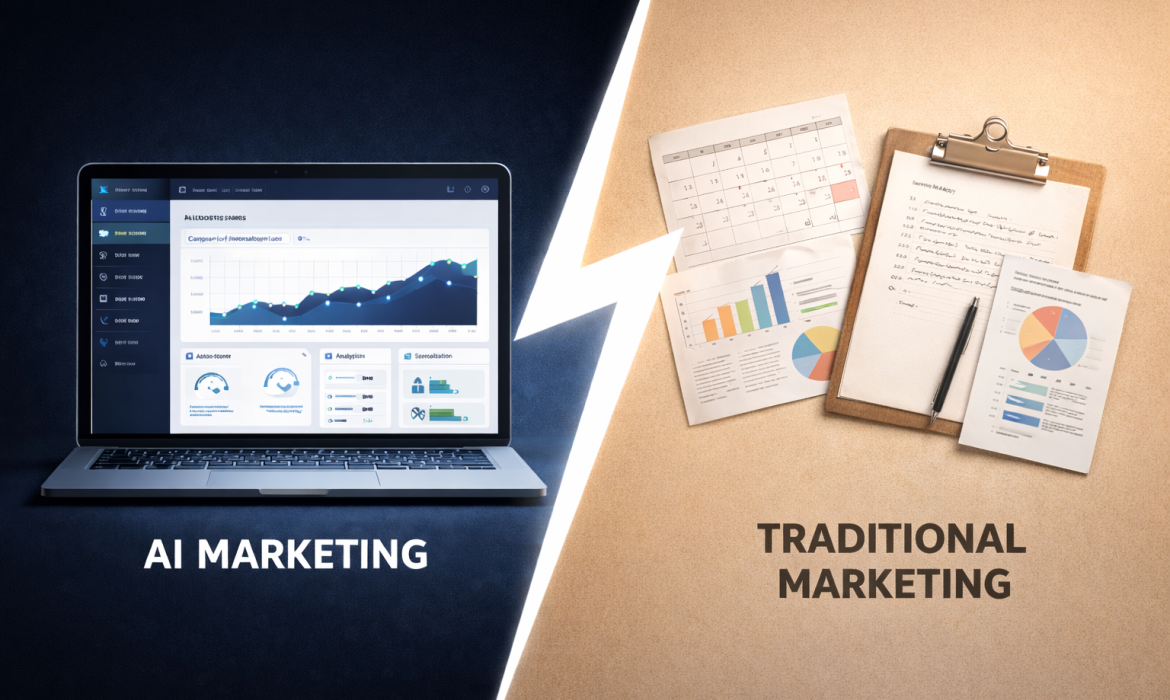
The marketing world is undergoing a major transformation. As artificial intelligence becomes deeply embedded in business operations, B2B leaders are re-evaluating how they attract, engage, and convert customers. Traditional marketing methods, once the backbone of B2B growth, are now being challenged by AI-driven strategies that promise speed, precision, and scalability.
Rather than asking whether AI will replace traditional marketing, the more relevant question for B2B leaders today is: how can both approaches be adapted to meet modern buyer expectations? This blog explores the differences, benefits, challenges, and the path forward for B2B marketing leaders navigating this shift.
Understanding Traditional Marketing in B2B
Traditional marketing has long played a foundational role in B2B growth. It focuses on established channels and structured strategies designed to build credibility and long-term relationships.
Brand Awareness and Trust Building
Traditional marketing methods such as print advertising, industry publications, trade shows, direct mail, and sponsorships have been effective in building brand recognition and trust. For B2B organizations, where buying cycles are longer and decisions involve multiple stakeholders, trust remains a critical factor.
Relationship-Driven Approach
B2B marketing has historically emphasized personal relationships. Face-to-face meetings, conferences, and networking events allow marketers and sales teams to build rapport with decision-makers. These interactions often play a key role in closing high-value deals.
Predictable and Structured Execution
Traditional marketing operates on well-defined timelines and processes. Campaigns are planned months in advance, budgets are fixed, and outcomes are evaluated after execution. This structure provides clarity but limits flexibility.
Limitations of Traditional Marketing for Modern B2B Leaders
While traditional marketing remains valuable, it struggles to keep pace with the speed and complexity of today’s digital-first environment.
Limited Personalization
Traditional marketing relies on broad audience segments. Messaging is often generalized, making it difficult to address the specific needs of individual buyers or buying committees.
Delayed Performance Insights
Campaign results are typically analyzed after completion, which limits real-time optimization. For B2B leaders, this delay can mean missed opportunities and inefficient spending.
Higher Costs and Lower Agility
Print media, large events, and offline campaigns require significant investment. Adjusting or pivoting mid-campaign is often costly and impractical.
The Rise of AI-Driven Marketing
AI-driven marketing represents a shift from intuition-based decision-making to data-driven intelligence. It uses machine learning, automation, and predictive analytics to improve how marketers plan, execute, and optimize campaigns.
For B2B leaders, AI is not just a tool, it is a strategic capability that enhances efficiency and effectiveness across the marketing funnel.
How AI Transforms B2B Marketing
Advanced Targeting and Personalization
AI analyzes large volumes of customer data, including behavior, engagement history, and intent signals. This enables highly personalized messaging delivered to the right audience at the right time.
Instead of one-size-fits-all campaigns, B2B leaders can create tailored experiences for different industries, roles, and stages of the buyer journey.
Real-Time Optimization
AI enables continuous monitoring of campaign performance. Marketers can adjust content, channels, and budgets in real time based on what is working, improving overall ROI.
This agility is especially valuable in competitive B2B markets where timing and relevance matter.
Marketing Automation at Scale
AI automates repetitive tasks such as lead scoring, email sequencing, content recommendations, and audience segmentation. This allows marketing teams to focus on strategy, creativity, and customer engagement rather than manual execution.
Predictive Analytics and Forecasting
One of AI’s biggest advantages is its ability to predict outcomes. By analyzing historical and real-time data, AI helps B2B leaders anticipate buyer behavior, forecast demand, and plan campaigns more effectively.
Key Benefits of AI for B2B Leaders
Improved Lead Quality
AI identifies high-intent prospects based on behavior and engagement patterns. This ensures sales teams focus on leads that are more likely to convert, reducing wasted effort.
Higher Marketing Efficiency
Automation and data-driven insights reduce operational costs over time. Campaigns become more targeted, resulting in better performance with optimized budgets.
Better Decision-Making
AI provides actionable insights rather than raw data. B2B leaders can make informed decisions backed by analytics instead of relying solely on assumptions or past experience.
Enhanced Customer Experience
Personalized content and timely interactions improve engagement throughout the buyer journey, strengthening relationships and increasing customer lifetime value.
Challenges of AI Adoption in B2B Marketing
Despite its advantages, AI adoption comes with challenges that B2B leaders must address.
Initial Investment and Integration
Implementing AI tools requires upfront investment in technology, integration with existing systems, and process changes. Without clear goals, adoption can become complex and costly.
Data Quality and Governance
AI depends on high-quality data. Inaccurate, fragmented, or outdated data can reduce effectiveness. Data privacy and compliance also require careful management.
Skill Gaps
Marketing teams may lack the technical expertise needed to fully leverage AI platforms. Upskilling and cross-functional collaboration become essential.
Risk of Over-Automation
Excessive reliance on automation can make marketing feel impersonal. Human creativity, empathy, and storytelling remain critical to building trust in B2B relationships.
Why Traditional Marketing Still Matters
AI does not make traditional marketing obsolete. Instead, it changes how traditional methods are used.
Human Connection and Emotional Impact
Brand storytelling, thought leadership, and creative campaigns still rely on human insight and emotional intelligence, areas where traditional marketing excels.
Credibility and Authority
Offline channels and industry presence help establish credibility. For many B2B buyers, seeing a brand consistently represented across trusted platforms reinforces confidence.
High-Value Relationship Building
Complex B2B deals often require personal interaction. Events, meetings, and partnerships continue to play a crucial role in relationship-driven sales.
The Hybrid Model: The Best Path Forward for B2B Leaders
The most successful B2B leaders are not choosing between AI and traditional marketing, they are combining them.
AI for Intelligence and Scale
AI enhances data analysis, personalization, automation, and performance measurement. It provides the speed and accuracy required in modern markets.
Traditional Marketing for Trust and Creativity
Traditional strategies preserve the human element, brand authenticity, and relationship-building that AI alone cannot replicate.
Integrated Execution
A hybrid approach ensures that campaigns are data-driven yet emotionally resonant. AI informs strategy, while human teams bring it to life through compelling narratives and experiences.
Actionable Steps for B2B Leaders
To adapt successfully, B2B leaders should consider the following steps:
- Start with Clear Objectives
Identify where AI can deliver immediate value, such as lead scoring or personalization.
- Strengthen Data Foundations
Invest in clean, unified, and compliant data systems.
- Upskill Marketing Teams
Encourage learning around AI tools, analytics, and digital strategy.
- Blend Channels Strategically
Use AI to optimize digital campaigns while leveraging traditional channels for credibility and relationship building.
- Measure Business Impact
Focus on metrics tied to revenue, pipeline growth, and customer retention rather than vanity metrics.
Conclusion:
The debate between AI and traditional marketing is no longer about replacement, it is about adaptation. AI empowers B2B leaders with intelligence, speed, and scalability, while traditional marketing grounds strategies in trust, creativity, and human connection.
The future of B2B marketing belongs to leaders who can balance innovation with authenticity. By adopting a hybrid approach, B2B leaders can stay competitive, build stronger relationships, and drive sustainable growth in an increasingly data-driven world.
I hope you find the above content helpful. For more such informative content, please visit SalesDemand.
FAQs:
1. What is the main difference between AI and traditional marketing?
AI marketing uses data, automation, and predictive analytics to personalize and optimize campaigns in real time, while traditional marketing relies on structured, manual processes and broad audience targeting. For B2B leaders, AI offers greater speed, precision, and scalability.
2. Why should B2B leaders adopt AI-driven marketing now?
Buyer expectations have shifted toward personalized and relevant experiences. AI enables B2B leaders to analyze intent, predict behavior, and engage prospects more effectively, helping them stay competitive in a digital-first market.
3. Can AI replace traditional marketing in B2B?
No. AI enhances marketing efficiency and intelligence but cannot fully replace human creativity, storytelling, and relationship building. The most effective approach for B2B leaders is a hybrid model that combines AI-driven insights with traditional marketing strengths.
4. What challenges do B2B leaders face when implementing AI marketing?
Common challenges include high initial investment, data quality issues, skill gaps within teams, and the risk of over-automation. Addressing these challenges requires clear goals, strong data governance, and continuous upskilling.
5. How can B2B leaders start integrating AI into their marketing strategy?
B2B leaders should begin by identifying high-impact use cases such as lead scoring, personalization, or campaign analytics. Building a strong data foundation and gradually scaling AI adoption ensures long-term success.